
a case study of’ ‘De strip’ (2002-2004) by artist Jeanne Van heeswijk
Introduction
Over the last decades in what has been often called ‘the social turn’ contemporary artists have been more and more concerned with relational aspects being an integral part of their artistic practices. This broad field has had different names such as socially engaged art, community-based art, experimental communities, dialogic art, littoral art, participatory, interventionist, research-based, or collaborative art. And its focus or outcome may vary depending on the artists, they share the conviction that collective action and shared ideas empower creativity (Bishop, 2008). This is evident when looking at different artists and artworks such as Kathrin Böhm and her long terms works focusing on the creation and continuous reconstruction of organisational infrastructures in the forms of collective identities (see the book Art on the scale of life), Sreejata Roy whose work engages with what public space is, and how the private space can perform as a public space (Sreejata Roy – Khoj, 2021) or going as far back as Joseph Beuys’ ‘Ausfegen’ in 1972 during which he took to sweeping the street with his students to challenge the relation between workers and artist as workers and making democratic change (Ausfegen – Centre Pompidou, n.d.)
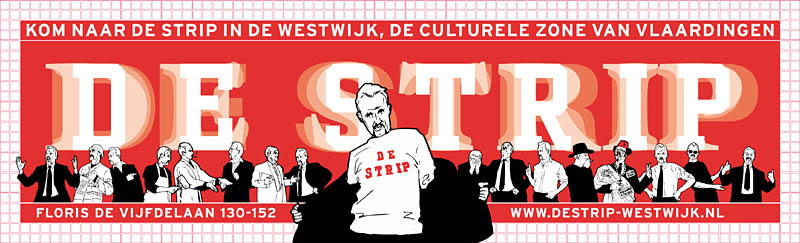
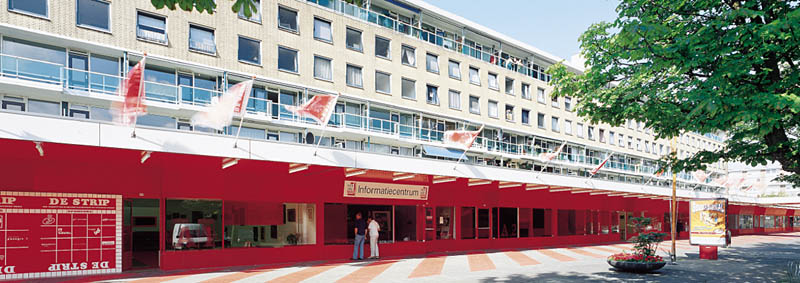
Participatory, community-based and socially engaged art are also terms that can be used to describe Jeanne van Heeswijk’s work and more specifically the project De Strip (2001-2004), during which a condemned shopping mall (or shopping strip, hence the name) in Westwijk – a district in the outskirts of the town of Vlaardigen in the Netherlands – was turned into a cultural centre for its residents. I chose to focus on this work for this case study.
My aim in this essay is to understand how the different aspects of the project are articulated, identify the principles on which they built and attempt to extract some sort of reproducible methodology. I chose ‘De Strip’ because its analysis will support the construction of my practical project proposal and I hope to use these identified aspects as part of my methodology.
Data collection
For the purpose of this case study, information and data regrouped about ‘De Strip’ come from a few primary sources such as Jeanne van Heeswijk’s own artist website, graphic designer and content advisor for the project’s official website Roger Teeuwen’s website and artist Peter Westenberg’s website.
Unfortunately I was not able to extract information from the original website for the project because it uses an outdated system. There are in total 54 pages and snapshots of the website kept in the Wayback Machine (powered by the Internet Archive) captured between 2005 and 2024. However, I wasn’t able to extract much data from it though because the entire website was in Dutch. Similarly, The now unaccessible World Wide Westwijk’s website was created to present Peter Westenberg and the Uit+Thuis videomagazijn project’s research results. It has also been captured on the Wayback Machine but is not usable. Finally I have been accessing databases listing public space and community oriented art and practices for more information about the project as well as interviews and articles about Jeanne’s own practice.
Conception
Jeanne Van Heeswijk was approached by the Vlaardingen City Council and the municipal Housing Corporation Waterweg Wonen as part of their Westwijk neighbourhood regeneration project to design a temporary intervention on the facade of one of the deserted service strip, programmed to be demolished 18 months later. (Bravo, 2018). In a move that she would later reproduce in the Het Blauwe Huis (The Blue House, 2005-2009) project, she turned this traditional public art opportunity into a sort of self-commission of community engaged art – she is quoted saying « I am quite often sort of half commissioned or I commission myself. » by O’neill about Het Blauwe huis – she instead offered to superficially restore the shops and convert them into a 3500m² centre for artistic production and exhibition. The space was named ‘De Strip’ and made to be able to host and adapt to a variety of different uses by architect François Xavier Guillon and the construction firm Panagro Ltd (Bravo, 2018, Van Heeswijk, n.d.).
From collective actors…
So while this opportunity for public art came from a traditional top-down approach – a promoteur commissioning an artist to embellish a building, van Heeswijk was able to flip this script into a facilitated grass-root approach and tried to include the public at all steps: contacted key community figures before the opening, assembled a team to manage De Strip with all parties represented in project meetings and their wishes taken in consideration when possible (van Heeswijk, n.d.).
It is to be noted at this point that Jeanne van Heeswijk had been working since 1995 on the project ‘Until we meet again’ as part of the regeneration process and integration of art in the Westwijk neighbourhood, and therefore was quite acquainted with the community which facilitated this shift and allowed De Strip to emerge (Teeuwen, 2004, van Heeswijk, n.d., Westen, 2003).
Among the cultural actors invited to interact with the local community we can find individual artists as well as institutions. Artists or craftsmen were invited, for periods of three months, to occupy free of charge the two studios that were built into the centre if they were willing to connect through their work and practices with the area and the residents (van Heeswijk, n.d., Westen, 2003). Boijmans Van Beuningen Museum and Showroom MAMA (Showroom for Media and Moving Art), institutions from Rotterdam, were invited to use one of the spaces. Their pre-existing resources, activities and strategies such as a permanent collection of contemporary, modern and applied art, lectures, educational events and research focusing on public and visual arts and culture relationships made them ideal collaborators in such a project (Bravo, 2018, Westen, 2003). The artist Peter Westenberg occupied for the whole duration of the project a shared space in the old supermarket with Showroom MAMA and created the Uit+Thuis videomagazijn. This was a facility for producing and projecting videos and served as the foundation for a number of workshops and events that actively employed video as a vital instrument to investigate relationships in the neighbourhood: residents were encouraged to produce videos as well as to access the video library (Bravo, 2018, Westen, 2003).
…to collaborative communities
As Bishop (2008) notes in her essay, a practice like van Heeswijk is « less interested in a relational aesthetic than in the creative rewards of collaborative activity—whether in the form of working with preexisting communities or establishing one’s own interdisciplinary network ». More specifically, van Heeswijk’s practice is a meeting point of both of these approaches: she is bringing her own extended peer community (artists, cultural institutions and museums) into pre-existing communities (neighbourhood) that she’s been working with or invited in. This meeting is generative, it creates interdisciplinary network of active collaborative communities.
The traditional relation to artistic processes and how to experience it is altered in these collaborative communities. We are no longer in a straight-forward approach where an artist is an individual in a specific location (the studio), doing an artwork a unique thing that exists within a specific location (the gallery) to be observed or experienced by the viewer an individual within that specific location. But an approach where « socialising », the collaborative process IS the moment of creation and needs the active participation of people involved in the urban fabric. The space was conceived to gather in one place several aspects of the creative process: artistic production, research, exhibition and mediation. Amateur, curious or passerby were therefore free to roam and get familiar with these ‘stages of an artwork’s life’ and explore which one they would have affinities with in a way that they might have not otherwise.
The artist as a mediator
Jeanne van Heeswijk describes her process both on her website and in various interviews as of a **mediator between situations, places and people** (Spatial Agency, 2010, Bravo, 2018).
Despite putting efforts into connecting to the different actors prior to the opening of the project, for which she had quite some time considering the neighbourhood regeneration project was first planned in 1995 before being pushed to 2001 for lack of funding (Bravo, 2018, Westen, 2003), by the artist’s own admission few people were at the opening of the project. We can safely assume then that getting in touch with the ‘key actors’ prior to the project while important cannot be the only tool used to connect with the community.
In the blue house project mentioned earlier in this essay but chronologically happening later, she is credited as « Commissioner / Artist » in collaboration with 2 other people (O’neill, 2012), but she lived at the beginning of the project 6 months in the house to prepare it literally both for habitation and connection with the growing local community. She then took a step back within the creative, collaborative, aspect of the project and took up the official role of advisor in the foundation that was created for dealing with the Blue House and mostly dealt with external factors that shaped the operations of the house such as fund seeking, public permission, civil laws. She called herself a « participating embedded observer, » but one who, together with other participants, watched and guided the project’s operational aspects (ibid.).
From the different accounts and narrations that I have been able to read, she seems to have kept the more present role of the mediator in ‘De strip’. She tried to create possibilities for people to develop and establish interest groups, little communities in themselves, through techniques that emphasise « acting together, » so that they may effectively discuss and bring about change on a neighbourhood level. (Spatial Agency, 2010)
Critically engage with the notion of ‘public’
In an interview with The Pew Center for Arts and Heritage (2017), van Heeswijk talked about her practice has a way « to understand what the common means, what public means ». In this project, it shines through that the public is considered as audience but also as actors. Despite the fact that few people came for the opening, word spread and the local residents became regular visitors, turned audience, turned participants. They came to events, took part in the project and aided with organisation or publicity (van Heeswijk, n.d.).
Their importance and involvement is also highlighted in van Heeswijk’s website. Out of the 319 participants to the project, 266 of them are listed by name (van Heeswijk, n.d.) which is a first node to their recognition. Participants here is being used in a quite wide sense from categories like Artist (75) to Funding body (7) including technician (4) (full category list and in Table 1 in the annexe). It wouldn’t be anything completely out of the ordinary for such a project, to list credit where credit is due, but the interesting categories are the following: Audience / Member (49) and Social worker / Host (19) which are respectively the second and third biggest categories in size after Artist.
This further shows that her practice’s goal is to « generate models that do justice to the complexity of the integration issue, » as van Heeswijk has been quoted by Spatial agency. As she sees it, the role of artist as a mediator entails questioning and confronting all parties involved, from children to city planners, from social workers to residents, and from « insiders » to « outsiders ». And to do that properly, social workers as hosts is especially important considering that Westwijk, as of the late 1990s and contemporary to the genesis of this project, is made of a culturally heterogenous population with immigrant families recently moved in and longer-term inhabitants with different cultural and social habits (Bravo, 2018)
A real-world place…
Van Heeswijk did not intend for De Strip to be an « isolated enclave for the arts » from her own words but a meeting place for activities of the residents and others (van Heeswijk, n.d.). With that principle in mind and acknowledging that this neighbourhood had been emptied of some services over the years and waiting for their regeneration, the strip also housed a small bookshop, a council information desk and a café, which the inhabitants could reserve for meetings and programmation (ibid., Westen, 2003). It allowed people with no connection with or feeling of belonging in the art world to also occupy the space and therefore allow encounters.
The reputation and status of the invited institutions (Showroom MAMA and the Boijmans Van Beuningen Museum) were also able to attract people from outside of the community to interact with it (Bravo, 2018). It connected Westwijk with the rest of the Netherlands and subverted ‘the disconnected, emptied and in need of regeneration outskirt of a small town 10km away from Rotterdam’ trope.
…connected in real-time
The project was supposed to last 18 months but its success allowed it to be extended by 6 (Bravo, 2018). One of the key element of that success besides the above mentioned principles is the project’s ability not only to connect to its surroundings but to become part of it. It was facilitated by having local issues being the focus of its program, renewed every 3 months. This program transpierced through all the spaces at the same time offering the possibility for cross reading them through different expressions (van Heeswijk, n.d.).
I haven’t been able to find confirmation of this but I suppose the time period set for the program’s renewal and the length of the residencies offered to the artists both being 3 months is not a coincidence and that they were synced, allowing artists to involve the community and connect with its current concerns. I would argue that this supposition is strongly supported by the artist’s recurring approach to dynamically involve community members in a particular cultural context in the planning of their surroundings and empower communities over their own “urban future” (ACT MIT, n.d.).
« Collective authorship »: a discussion
In her interview with the Pew Center, Jeanne van Heeswijk says that « co-authorship or collective authorship » is at the centre of her practice. But does co-authorship means a completely horizontal structure of an equally shared authorship? It does not appear to be quite universally understood, seeing as we can find different denomination to talk about the stakeholders, participants and instigators of this project across different sources. Without surprise, van Heeswijk seems to be the one putting the biggest emphasis on everyone sharing authorship at a horizontal level: she only lists participants (319) and visitors (48,000). An audience / member, a curator, a funding body or a company / foundation for example are all listed without hierarchy under the same label: « participants ». On the database Public Space however, Museum Boijmans Van Beuningen and Showroom MAMA the cultural institutions invited by the artist get credited as « developer », van Heeswijk is credited as « author » alongside François Xavier Guillon and Koos de Witt the architects, and the residents get credited as « Collaborators: Inhabitants of Westwijk ».
In her quite critical essay on socially engaged art, art critic Claire Bishop (2008) cites ‘De strip’ as one of the then recent example of « artistic interest in collectivity, collaboration, and direct engagement with specific social constituencies ». One of her main point is that when assessing such an artwork the attention is on the author’s intentionality, or rather, the « humble lack » of it, rather than the work’s conceptual value as a social and artistic form. And that as a consequence a generalised set of moral principles is prioritised over the disruptive specifics of a particular work. While she only reference to ‘De Strip’ in the introduction of her essay and not directly in the examples of collaborative works that she criticises the most, the implication is that she puts them in the same category, as she then goes on the list a few of the « good examples » of collaborative art according to her. When assessing them, she highlights that the « intersubjective relations » were not the goal of the artwork but a mean to unfold concerns of « pleasure, visibility, engagement, and the conventions of social interaction ». I would argue that ‘De Strip’ does exactly that: it engages and (re)generates a network of relations in a context where it was disappearing, brought to the forefront and challenged the question of margin/center in an urban and social context. It was also quite prolific in term of type of outputs: 102 events, 2 websites (http://www.destrip-westwijk.nl, http://www.worldwidewestwijk.nl/) and at least 2 specific art publications:
- World Wide Westwijk, a booklet with cd-rom from Uit+Thuis Videomagazij_n by Peter Westenberg, published by CBK, Rotterdam in 2004
- 2002-2004 Westwijk, Vlaardingen, De Strip by Jeanne van Heeswijk, edited by Maartje Berendsen, authors include Siebe Thissen, Rein Wolfs and Mirjam Westen. The 292 page book was published in a limited edition by Amsterdam: Artimo and Foundation Breda in 2004. It also included a World Wide Westwijk cd-rom.
Relevance nowadays
‘De Strip’ is 20 years-old this year. How is the tradition of occupying store fronts still relevant?
The Festival Survival Kits is organised by the Latvian Centre for Contemporary Art (LCCA) since 2009. It started as a reaction to the economic crises The location that the festival chooses to be held at —vacant buildings in Riga—is a crucial component of the event’s character. It allows the festival, artists and visitors to explore the buildings’ potential and possible development methods for their revitalisation.
« YOUR IDEA HERE: A Toolkit for Unlocking the Community Potential of Vacant Storefronts » was written in 2012 by Beth Evanson in partnership with Saint Anthony Park Community Council and supported by CURA, the Centre for Urban Regional Affairs of the university of Minnesota (USA). It uses the knowledge gathered during the project Saint Anthony Park Pop-Up Shop – created in reaction to 4-year-long construction works that were being done and harming short-term local economy – and provides practical tools, from budgeting to approaching renters and local stakeholders, for artists and collective wanting to occupy such a space.
These projects seem to stem for a reaction to a crisis or a willingness to re-engage with public spaces differently. Both of which are very relevant nowadays as post-pandemic cities are rearranging their public spaces away from closed commercial centres and are working to promote a fairer distribution of public space among various user groups and forms of transportation, among other changes. (Brouderoux, 2021)
« For most people, storefronts are the main interface with the work being done in their community, and the main indicator of whether or not their community is thriving. » (Evanson, 2012)
Since March 2024, the collective Maisuno+1 have been lent some unoccupied storefront in the metro station Picoas in Lisbon by the Metrocom and they have been successfully running the residency « Play the (under)Ground ». There is still space – literal and figurative – to explore community from a storefront in 2024. (Maisuno+1, 2024)
So, while occupying empty building for artistic investigations is not a new phenomena it still is a practice that holds great explorative and generative potential. I’m hoping that the practical, real-world tools that it contains will be a good complement to the artistic methodology extracted in this case study.
Conclusion
What is left today of ‘De Strip’, 20 years later, for non participants, such as myself, is multiple accounts of the project on databases, obsolete websites and an out-of-stock publication probably available in some libraries. However, what is also left for us is a methodology and a successful example to reference to where institutions trusted an artist and delegated to their own community the community and social network building process.
Jeanne van Heeswijk’s methodology seems effective and the priojects she has been developping since ‘De Strip’ consolidate that. She identifies stakeholders and needs of a specific community, contacts parties early in the project to create a meeting point. She brings her own interdisciplinary-peer-network into a pre-existing community to create an active collaborative community. Her role as an artist is the one of a mediator between situations, places and people. She engages with the ‘public’, through active participation, and with the notion of ‘public space’ through time – by having local issues being the focus of its 3-month-long program – and place – where different aspects of the artistic process coexist within a same space. She also engaged with the dichotomy margin/centre. A certain horizontality seems to be of value to her process as well, even if the notion of co-authorship can be criticised and understood differently among parties.
We can see clearly how van Heeswijk wants her projects – and ‘De strip’ is no exception – to become a place for people to engage critically with the notion of public space and to study it and intervene on it, both from within it and outside it. She saw something that was a problem and turned it into a possibility (and so successfully that it was prolonged by 6 months).
References
Ausfegen – Centre Pompidou. (n.d.). Centre Pompidou. Retrieved May 29, 2024, from https://www.centrepompidou.fr/en/ressources/oeuvre/cz9BBq
Bishop, C. (2008). 16 The Social Turn Collaboration and Its Discontents. In Stanford University Press eBooks (pp. 238–255). https://doi.org/10.1515/9781503627253-018
Bravo, D. (2018, June 18). works: “The Strip” (J. Wark, Trans.). PublicSpace. Retrieved May 10, 2024, from https://www.publicspace.org/works/-/project/d217-the-strip
Broudehoux, A. M. (2021, January 3). Post-pandemic cities can permanently reclaim public spaces as gathering places. The Conversation. Retrieved May 25, 2024, from https://theconversation.com/post-pandemic-cities-can-permanently-reclaim-public-spaces-as-gathering-places-150729
Evanson, B. & Saint Anthony Park Community Council. (2012). YOUR IDEA HERE: A toolkit for ulocking Community Potential of Vacant Storefronts (NPCR Report # 1345). CURA – Centre for Urban Regional Affairs, University of Minnesota.
Jeanne van Heeswijk. (n.d.). Art Culture Technology MIT. Retrieved May 27, 2024, from https://act.mit.edu/about/people/jeanne-van-heeswijk/
Jeanne van Heeswijk. (2010). Spatial Agency. Retrieved May 11, 2024, from https://www.spatialagency.net/database/why/pedagogical/van-heeswijk
Jeanne van Heeswijk – De Strip 2002 – 2004 Westwijk, Vlaardingen – Archive – de Appel Amsterdam. (n.d.). Retrieved May 29, 2024, from https://www.deappel.nl/en/archive/books/18371-jeanne-van-heeswijk-de-strip-2002-2004-westwijk-vlaardingen
Kathrin Böhm. (n.d.). Sternberg Press. https://www.sternberg-press.com/product/kathrin-bohm/
mais uno +1. (2024). Play(TheUnder)ground. Mais Uno +1. Retrieved May 29, 2024, from https://maisunomaisum.pt/Play-TheUnder-ground-ENG
O’neill, P. (2012). The Blue House (Het Blauwe Huis). In P. O’neill & C. Doherty (Eds.), Locating the Producers: Durational Approaches to Public Art (pp. 17–77). Antennae Valiz.
Questions of Practice: Visual Artist Jeanne van Heeswijk on Collective Authorship. (2017, April 11). The Pew Center for Arts & Heritage. Retrieved May 12, 2024, from https://www.pewcenterarts.org/post/questions-practice-visual-artist-jeanne-van-heeswijk-collective-authorship
Sreejata Roy – Khoj. (2021, May 17). Khoj. Retrieved May 29, 2024, from https://khojstudios.org/person/sreejata-roy/
Survival Kit. (n.d.). Latvian Centre for Contemporary Art. Retrieved May 28, 2024, from https://lcca.lv/en/survival-kit/
Teeuwen, R. (2003, August 30). DE STRIP. Roger Teeuwen Graphic Designer. Retrieved May 26, 2024, from http://www.rogerteeuwen.nl/weblog3/archives/000040.html#_blank
Teeuwen, R. (2004, May 22). Stripboek. Roger Teeuwen Graphic Designer. Retrieved May 26, 2024, from http://www.rogerteeuwen.nl/weblog3/archives/000075.html#more
uit+thuis videomagazijn. (n.d.). Retrieved May 26, 2024, from http://www.videomagazijn.org/uit+thuis/index.html
Van Heeswijk, J. (n.d.). De Strip. Jeanneworks, Typologies & Capacities. Retrieved May 3, 2024, from https://www.jeanneworks.net/projects/de_strip/
Wayback Machine Welkom de STRIP. (n.d.). The Web Archive. Retrieved May 20, 2024, from https://web.archive.org/web/20221211233310/http://www.destrip-westwijk.net/
Wayback Machine World Wide Westwijk. (n.d.). The Web Archive. Retrieved May 20, 2024, from https://web.archive.org/web/20050215000000*/http://www.worldwidewestwijk.nl/
Westen, M. (2003, July). The Artist as Versatile Infiltrator of Public Space. Retrieved May 26, 2024, from https://www.jeanneworks.net/essays_interviews/the_artist_as_versatile_infiltrator_of_public_space/
Westenberg, P. (n.d.). Program: 2Bthuis. Peter Westenberg. Retrieved May 22, 2024, from http://www.videomagazijn.org/westenberg/pages/programs/uit%2Bthuis.html
Westenberg Peter World-Wide-Westwijk. (n.d.). Walgenbach Art & Books Rotterdam. Retrieved May 25, 2024, from https://www.walgenbach.nl/product/westenbergpeter-world-wide-westwijk/
Westwijk, Vlaardingen, De Strip. (n.d.). CHRIS DOBROWOLSKI. Retrieved May 28, 2024, from https://www.chrisdobo.com/westwijk-vlaardingen-de-strip.html
Worldwidewestwijk publicatie. (2004, May 22). Roger Teeuwen Graphic Designer. Retrieved May 20, 2024, from http://www.rogerteeuwen.nl/weblog3/archives/000082.html#more
Annexe:
Table 1: different categories of “participants” and the number
| 75 | Artist |
| 49 | audience members |
| 19 | social worker / Host |
| 17 | company / foundation |
| 16 | performer |
| 11 | musician |
| 9 | curator |
| 7 | funding bodies |
| 7 | civil servant |
| 6 | designer / maker |
| 6 | writer / Researcher |
| 5 | commissioner |
| 5 | photographer |
| 4 | architect |
| 4 | organiser |
| 4 | technician |
| 3 | radio / TV maker |
| 3 | editor |
| 3 | film/ video maker |
| 3 | creative coder |
| 3 | art historian |
| 2 | activist |
| 2 | publisher |
| 2 | educator |
| 1 | philosopher |
Cover and in-text photographs and illustrations are from Roger Teeuwen’s website.